If you have decided you want a fire pit in your Maryland backyard — great decision. Now comes the next question that almost every Maryland homeowner faces: gas or wood burning?
Both are genuinely excellent options. Both deliver the warmth, ambiance, and outdoor gathering experience that makes a fire pit one of the most used features in any Maryland backyard. But they are meaningfully different in terms of convenience, cost, maintenance, safety, and the overall experience they create.
This guide gives Maryland and Delaware homeowners a complete, honest comparison — so you can choose the fire pit fuel type that actually fits your lifestyle, your property, and how you want to use your outdoor space.
Before getting into the practical comparisons, it is worth acknowledging the most fundamental difference between gas and wood-burning fire pits — the experience of using them.
Wood-burning fire pits deliver the authentic campfire experience. The crackling sound, the wood smoke smell, the dancing irregular flames, the process of building and tending the fire — these are things that no gas product fully replicates. For many Maryland homeowners, this sensory authenticity is the entire point of having a fire pit. The ritual of a wood fire — gathering wood, building the fire, watching it develop — is itself part of the enjoyment.
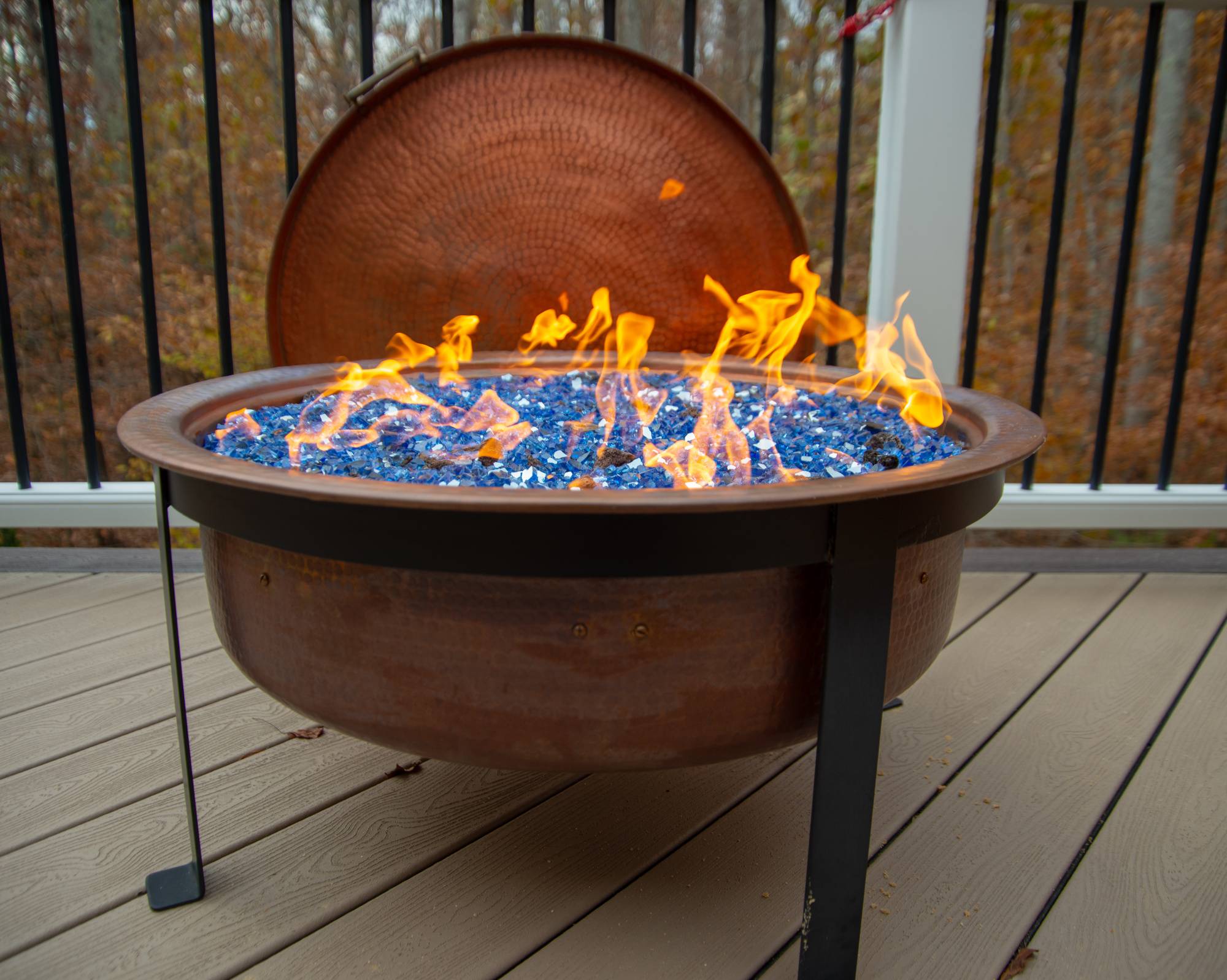
Gas fire pits deliver a clean, controlled, immediately available flame. Turn a valve or push a button and the fire is on. Adjust it up or down. Turn it off completely when you are done. No smoke, no ash, no embers to manage. The flame in a quality gas fire pit is genuinely beautiful — especially with glass beads or decorative lava rock media. But it is a different experience than a wood fire, and being honest about that difference matters when choosing.
This is where gas wins decisively.
Gas fire pit convenience: Turn it on, enjoy the fire, turn it off. No wood to source, store, or carry. No fire building process. No waiting for the fire to develop. No ash to clean up the next day. No embers to monitor before you go inside. A gas fire pit is as convenient as a gas stove — it is ready when you are and done when you are done.
Wood-burning fire pit convenience: Wood must be sourced — either purchased and delivered or collected from your property. It must be stored dry, which requires a covered storage area. Each fire requires building — tinder, kindling, fuel logs in the right configuration. The fire takes time to develop. And when you are done for the evening, you wait for embers to fully extinguish before going inside, or carefully extinguish them with water. Ash cleanup happens the next day.
For Maryland homeowners who want a fire available spontaneously on any given evening — whenever the mood strikes — gas is significantly more practical. For homeowners who enjoy the process and ritual of a wood fire, this difference is not a drawback at all.
Upfront installation cost:
Gas fire pits have higher upfront installation costs because they require a gas line connection — either a natural gas line run from the house or a propane tank hookup. The gas line work requires a licensed plumber or gas line contractor in Maryland and adds $500–$2,000+ to the project cost depending on the distance from the gas supply.
Wood-burning fire pits do not require any utility connections. The cost is for the construction of the fire pit structure itself.
Ongoing operational cost:
Gas: Natural gas is relatively inexpensive for fire pit use in Maryland. A typical evening's fire use costs a few dollars in natural gas. Propane costs more per BTU than natural gas but is still modest for occasional use.
Wood: Seasoned firewood in Maryland typically costs $200–$400 per cord. A typical fire pit season (September through November in Maryland) might use half a cord to a full cord depending on frequency of use — $100–$400 per season.
The cost comparison is close over time — gas wins on convenience and the upfront cost difference is partially offset by the gas line installation requirement.
Both gas and wood-burning fire pits are safe when properly designed, installed, and used. But their safety considerations are different.
Gas fire pit safety: No open embers means no risk of stray sparks landing on combustible surfaces or nearby plants. The fire is fully controlled and can be extinguished instantly. No risk of fire spreading beyond the feature itself when the gas is turned off. Main safety considerations are gas line integrity, proper ventilation for enclosed spaces, and keeping combustibles away from the live flame area.
Wood-burning fire pit safety: Sparks and embers are the primary safety consideration. In Maryland, where decks, pergolas, and mature trees are common in outdoor spaces, a spark screen over a wood-burning fire pit is strongly recommended. County regulations in Maryland and Delaware may restrict open wood fires on certain days, particularly during dry conditions. The minimum 10-foot clearance from any combustible structure applies to both types but is more actively relevant for wood-burning pits where sparks are a real variable.
Safety advantage: Gas — particularly for Maryland properties with pergolas, wood decking, or significant nearby vegetation.
Gas fire pit maintenance: Annual inspection of the gas line connection and burner components is recommended. The burner and gas jets should be cleaned periodically to remove debris. Glass beads or lava rock media should be rinsed and inspected. Beyond this, a well-installed gas fire pit in Maryland requires minimal maintenance.
Wood-burning fire pit maintenance: Ash must be removed after each use or at least periodically. The firebox should be inspected for cracking seasonally. The spark screen (if used) needs periodic cleaning. Wood storage area must be maintained to keep wood dry and pest-free.
Maintenance advantage: Gas — modestly simpler ongoing maintenance.
In our experience working with Maryland homeowners, the choice often comes down to one primary factor: how spontaneous do you want the fire experience to be?
Homeowners who want to sit down after dinner on a Tuesday evening and have a fire going within 30 seconds consistently choose gas. Homeowners who look forward to the ritual of building a fire on weekend evenings and who love the authentic campfire experience consistently choose wood burning.
There is no wrong answer. Both create a fire pit that Maryland homeowners love and use regularly. The key is being honest about which experience actually matches your lifestyle.
This is a common question — and the answer is: sometimes, but it is more complicated and expensive than installing gas initially. Retrofitting a gas burner insert into an existing wood-burning fire pit requires evaluating the existing firebox for safe gas installation, running the gas line, and installing appropriate burner components. In some cases the existing structure works well for conversion; in others, the firebox dimensions or materials are not ideal for a gas installation.
If you think you might eventually want gas, it is worth at least running a gas conduit to the fire pit location during initial construction — even if you do not connect the gas line initially. This significantly reduces the cost of a future conversion.

At Unlimited Landscaping, we design and build both gas and wood-burning fire pits for homeowners across Maryland and Delaware. We will help you evaluate which option fits your lifestyle and property — and build a fire feature that becomes the most used spot in your backyard.
Request your free fire pit estimate today.
Unlimited Landscaping — Where Your Outdoors Has No Limits.


