
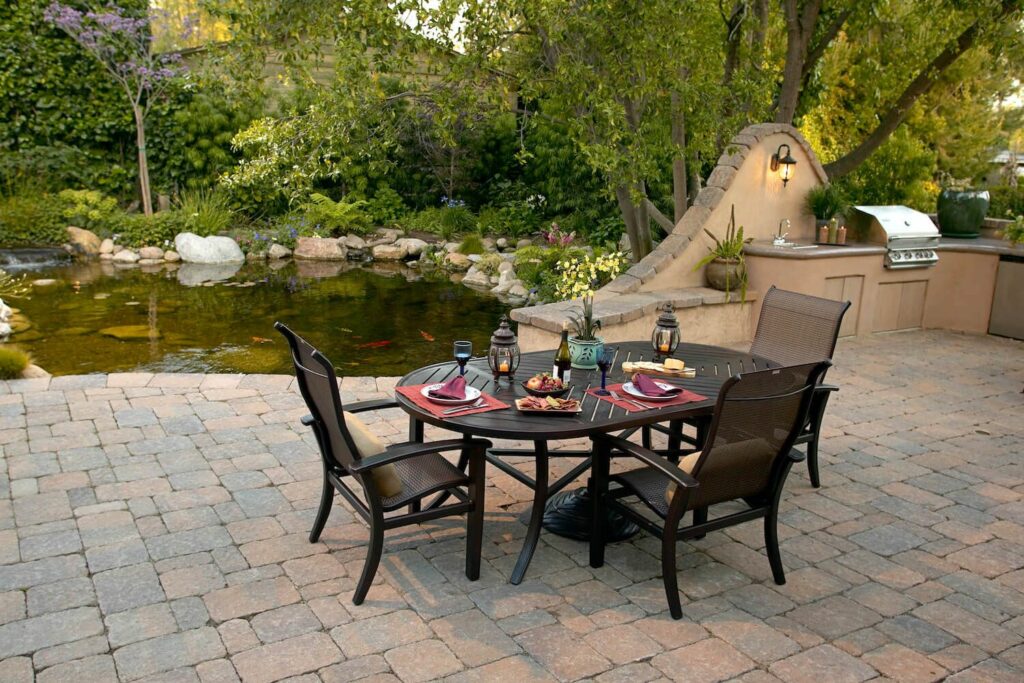
If you are planning a new patio in Maryland and have done any research at all, you have run into the same question that every Maryland homeowner eventually faces: should I go with pavers or concrete?
Both are excellent patio materials. Both are widely used across Maryland and Delaware. Both can look beautiful when properly designed and installed. And both have clear advantages that make them the right choice in specific situations.
This guide gives you the complete, honest comparison — cost, durability, maintenance, appearance, repairability, and long-term value — so you can make the right decision for your specific property, budget, and goals.
A concrete patio is a single, continuous poured slab. Liquid concrete is poured into a formed area, leveled, finished, and left to cure as one unified surface.
A paver patio is made of individual units — concrete, brick, or natural stone — installed over a compacted crushed stone base and bedding sand in a specific pattern. Each piece sits independently.
This fundamental structural difference is what drives most of the practical differences between the two options in Maryland.
Concrete patio cost in Maryland:
Paver patio cost in Maryland:
For a 400 sq ft patio — a comfortable size for most Maryland backyards — concrete typically runs $2,400–$8,800 depending on finish, while concrete pavers run $6,000–$10,000.
The upfront cost advantage goes to concrete. Plain or decorative concrete is almost always less expensive per square foot than pavers for the same area. However, the cost comparison changes significantly when you factor in long-term maintenance and repairability — which is where pavers often win.
Maryland's freeze-thaw cycles are the most important durability test for any patio material. When water gets into cracks or beneath a surface and freezes, it expands — creating pressure that damages hardscaping.
Concrete durability in Maryland: A poured concrete slab is a single rigid surface. When the ground beneath it moves — due to frost heave, settling, or drainage changes — the slab has nowhere to flex. It cracks. In Maryland, concrete patio cracking over time is extremely common, especially in slabs that were not installed with adequate sub-base preparation or proper control joints.
Paver durability in Maryland: Individual pavers can flex and move slightly with ground movement rather than cracking. When frost heave shifts the ground beneath a paver patio, individual pavers lift slightly and then settle back — without the damage that a rigid slab experiences. This makes paver patios inherently better suited to Maryland's freeze-thaw climate.
Durability advantage: Pavers — particularly for Maryland's freeze-thaw conditions.
This is one of the clearest advantages pavers have over concrete in Maryland, and it compounds in value over time.
Concrete repair in Maryland: When a concrete patio cracks — and in Maryland, it eventually will — repairing it seamlessly is essentially impossible. Concrete patches are always visible. Color-matching new poured concrete to weathered existing concrete is difficult. The only true fix for significant concrete cracking is removal and replacement of the affected section, which is expensive and disruptive.
Paver repair in Maryland: When a paver cracks, shifts, or settles unevenly, you remove the affected piece or pieces, address the base if needed, and reinstall. The repair is invisible in the finished surface. Individual pavers can also be replaced if stained, chipped, or damaged without affecting the surrounding installation.
Repairability advantage: Pavers — clearly.
Concrete appearance: Plain concrete is utilitarian. Decorative concrete — stamped, stained, or exposed aggregate — significantly expands the design possibilities and can deliver beautiful results. Stamped concrete can closely mimic stone or brick patterns. However, the stamped appearance fades somewhat over time as the sealant wears, and the pattern can look slightly artificial up close.
Paver appearance: The design flexibility of pavers is essentially unlimited. Dozens of shapes, sizes, colors, and textures are available. Pattern options — herringbone, running bond, basketweave, multi-size, random — add visual complexity that a single poured surface cannot replicate. Natural stone and porcelain pavers in particular deliver an aesthetic richness that no decorative concrete finish fully matches.
Appearance advantage: Subjective, but most Maryland homeowners and real estate professionals rate paver patios as more attractive and higher-end in appearance than decorative concrete.
Concrete maintenance in Maryland: Concrete patios should be sealed every 2–3 years in Maryland to protect against moisture penetration, staining, and freeze-thaw damage. Sealing decorative concrete is particularly important to maintain the color and pattern. Unsealed concrete in Maryland's climate deteriorates noticeably faster.
Paver maintenance in Maryland: Pavers should have joint sand replenished periodically as it settles over time. Sealing pavers every 3–5 years enhances color and protects against staining. Weeds can occasionally establish in joints if maintenance is deferred. Overall, paver maintenance requirements are similar to concrete — regular sealing and occasional joint attention.
Maintenance advantage: Roughly equal, with concrete requiring slightly more frequent resealing of decorative finishes.
When Maryland homeowners ask which is the better long-term investment, the honest answer for most properties is pavers — for two reasons.
First, pavers handle Maryland's freeze-thaw climate better and are easier to repair, meaning they retain their appearance and function longer without major intervention.
Second, paver patios consistently score higher in perceived value among Maryland home buyers. When two otherwise comparable Maryland homes are on the market — one with a paver patio and one with a concrete patio — the paver patio is consistently perceived as a more premium feature.
The higher upfront cost of pavers is real. But spread over a 20–30 year lifespan with lower repair costs and higher resale contribution, the long-term economics often favor pavers.
Despite pavers winning most of the long-term comparisons, concrete is the right choice in specific Maryland situations.
Large surfaces on a tight budget. For a very large patio — 800 sq ft or more — the cost difference between concrete and pavers becomes significant. Plain or decorative concrete may be the only realistic option within a defined budget.
Specific decorative finish goals. Exposed aggregate concrete and high-quality stamped concrete deliver a look that has no direct paver equivalent. If one of those specific aesthetics is what you want, concrete is the right material.
Speed. A concrete slab installs faster than a paver field of equal size. If timeline is the primary constraint, concrete has an advantage.
For most Maryland homeowners investing in a patio with long-term quality and value in mind, concrete pavers are the better investment. The freeze-thaw performance, repairability, design flexibility, and perceived value advantages outweigh the higher upfront cost for most properties and most goals.
For homeowners working within tighter budgets or targeting a specific decorative finish, concrete is a completely legitimate and attractive choice — provided it is installed with proper base preparation, adequate thickness, and appropriate control joints for Maryland's climate.

At Unlimited Landscaping, we install both paver and concrete patios for homeowners across Maryland and Delaware. We will help you evaluate which option makes the most sense for your specific property, style, and budget — and install it properly so it performs for decades.
Request your free patio estimate today.
Unlimited Landscaping — Where Your Outdoors Has No Limits.


